
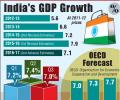
Rating firm Crisil revised downwards its GDP growth forecast to 5.5 per cent this fiscal from its earlier estimate of 6 per cent, citing reduced likelihood of monetary easing going forward due to falling rupee.
'I expect fourth quarter GDP growth to be sharply down.' 'I would imagine it would shave off at least one percentage point, if not more, as compared to the third quarter.'

While most economies contracted in the second quarter of 2020, the Chinese economy grew by 3.2 per cent.

The real requirement for the finance minister's explanatory speech is to explain the measures taken in the Budget to influence inflation and growth not just through the announcement of a deficit goal, but more broadly through the impact on money supply, consumer demand, foreign trade and investment, explains Nitin Desai.

Of the seven surveys presented under Modi govt, predictions of three were quite close to the actual GDP growth rate, one saw the base year change in between, but the last three were way off the mark.

Only power generation grew faster in 2014 than in earlier years.

Moody's on Thursday raised India's GDP forecast for the calendar year 2020 upwards to -8.9 per cent contraction from -9.6 per cent contraction forecast earlier. Similarly, India's GDP forecast for the calendar year 2021 has been revised upwards to 8.6 per cent from 8.1 per cent projected earlier. The report released by Moody's Investors Service attributed the reason behind better growth to the falling of coronavirus cases in the country.
The Reserve Bank of India on Friday decided to leave benchmark interest rate unchanged at 4 per cent but maintained an accommodative stance as the economy faces heat of the second Covid wave.

Under the new methodology, the base year has been changed from 2004-05 to 2011-12 and also in conformity with the international practice, the GDP is now measured at market prices.

the GDP estimates incorporate new source data and modified compilation techniques

While India's GDP growth slowed to five-year low of 5.8% in Q4, China grew at 6.4%.

It said that the GDP growth has averaged 7.3 per cent from 2014-15 to 2017-18, which is the highest among the major economies of the world.

China, the world's second largest economy, in a rare move on Monday lowered its GDP for 2012 by 0.1 percentage point to 7.7 per cent, the lowest in 14 years as the communist giant grapples with economic slowdown.

Delivering a public speech hours after the RBI launched a rescue act for Yes Bank on March 6, Governor Shaktikanta Das reiterated the RBI's affirmation to do whatever was needed to combat the coronavirus impact. On that day, India had only one confirmed COVID-19 infection, the World Health Organisation was five days off from declaring it as a pandemic and the financially debilitating lockdowns were not even on the horizon. Das' promise on efforts to mitigate COVID-19 impact appeared as a footnote in news reports from the event.
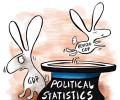
New estimates of India's gross domestic product (GDP) are "puzzling", Arvind Subramanian, chief economic adviser at the finance ministry, said on Friday.

The Reserve Bank of India (RBI) on Friday kept the key repo rate unchanged at 4 per cent in view of rising inflation and faint signs of economic growth amid the gradual lifting of coronavirus related countrywide lockdown.

Sandwiched between demonetisation, GST and other smaller policy changes, Gross Value Added or GVA may be a more reliable measure of economic activity over the next few quarters.

But Indians work less than smaller countries with small populations like Bhutan, the Congo, Lesotho and Gambia.

Government has forecast annual economic growth to rise to 7.4%.

'The long-term impact of elections is minimal.'

'The prime minister's comment on 'revdi culture' was welcome. But I am disappointed he did not follow up on that.' 'All political parties, including the BJP, have been guilty of this.' 'Now, Modi's guarantees, the Congress's 'nyay' path and both ruling and Opposition parties are vying with each other for freebies in my home state Andhra Pradesh.'

'What happened to Andhra Pradesh? It is the perfect example of the transientness of Federal Units.' 'Federalism is a transient thing in this country.'
But lower growth numbers in the quarters to come may not mean renewed weakness in the economy at the ground level, says Pranjul Bhandari.

The BSE mid-cap and small-cap stocks have outperformed the benchmark Sensex in 2023-24 with about 62 per cent returns, reflecting buoyant investors' sentiment amid robust macroeconomic conditions in the country and impressive quarterly earnings reported by various firms. As per an analysis, the BSE mid-cap gauge jumped 15,013.95 points or 62.38 per cent in the 2023-24 fiscal, while the small-cap index climbed 16,068.99 points or 59.60 per cent. In comparison, the 30-share BSE Sensex raked in a gain of 14,659.83 points or 24.85 per cent during the fiscal under review.

Hospitality and travel sector players on Tuesday demanded infrastructure status for the hotel industry besides measures such as tax exemption on LTA annually to boost domestic tourism ahead of the Union Budget. They also recommended removal of the current TDS levied on automated bookings for internal or closed user groups such as business travel platforms and reducing the total number of licenses required to establish a hotel. "A full-blown infrastructure status for the hotel sector and further rationalisation of the Goods and Services Tax (GST) and a Central single window clearance for hotel projects are some of the major expectations from the Budget 2024," Roseate Hotels & Resorts CEO Kush Kapoor said in a statement.

Economic growth is likely to plummet to a multi-decade low of 1.6 per cent in fiscal year 2020-21 due to the Covid-19 pandemic and ensuing measures like lockdowns and social distancing, an American brokerage said on Wednesday in one of the bleakest forecasts on GDP yet. Indian policymakers have not been aggressive enough in their response till now to the crisis, and will need to eventually intensify their efforts, economists at Goldman Sachs said.
The brokerage said the consolidated fiscal deficit, including that of the Union (3.6 per cent), the states (2.6 per cent) and the off-budget borrowings which are being resorted to increasingly is a worry.
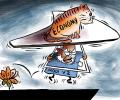
India's growth outlook has weakened sharply this year, with a crunch that started with the non-banking finance institutions spreading to retail businesses, car-makers, home sales and heavy industries.

It is pegged at 6.8-8% by various economists, as compared to 6.7%.

'What happens in the real estate market is that once the prices go up it goes on to stay at that level.' 'It might not increase and at the same time the prices will not come down too.'

"A significant decline in the growth number for this quarter is highly likely, but for the fiscal year as a whole the decline may still be relatively moderate," Fitch Asia-Pacific Sovereigns Group Director Thomas Rookmaaker said.

The central government is likely to further consolidate its fiscal deficit by 50 basis points (bps) to 5.9 per cent in FY24 from 6.4 per cent in FY23, according to a recent report released by Goldman Sachs on Tuesday. In the current fiscal year, there is going to be an upside of 0.5 per cent on the receipts side due to higher nominal GDP growth, and higher tax buoyancy because of the formalisation, the report said. The upside to expenditure is mainly going to come from incremental subsidies (0.8 per cent of GDP), in both food and fertilizer, it said. The upcoming pre-election Budget will carry forward the trend of the increased capital expenditure seen in recent years.

Get more people working, get more people working in modern manufacturing and services in our cities, and get people working better and longer, suggests Naushad Forbes, past president, CII.

India's bank credit remains resilient and is showing no signs of systematic risk, Reserve Bank of India (RBI) Deputy Governor Michael Patra said on Monday. A copy of the speech was uploaded on the RBI website on Thursday. "Bank credit is monitored as a lead indicator of overheating. Our assessment, based on a menu of approaches, indicates that current rates of credit expansion are not pointing to systemic stress building up. Illustratively, the credit gap - the difference between the credit to GDP ratio and its trend - is currently negative," said Patra, while delivering a speech in Cambodia.

S&P also cut China?s GDP growth forecast to 7.5%t and that of rest of Asia.

The International Monetary Fund (IMF) warned on Tuesday that India's general government debt (comprising both central and state government debt) could exceed 100 per cent of gross domestic product (GDP) in the medium term. It also cautioned that long-term debt sustainability risks are high due to the significant investment required to meet India's climate change mitigation targets. The Indian government, however, disagreed, arguing that risks from sovereign debt are extremely limited as it is predominantly denominated in domestic currency.
Calling out the high real interest rates -- the differential between the policy rate and headline inflation -- as an impediment to investment, the SBI report said the RBI can cut rates by 0.35-0.50 per cent at its next policy announcement.

The finance ministry on Tuesday cited "green shoots" of recovery in agriculture, manufacturing and services sectors, and said the prompt policy measures taken by the government and RBI have helped reinvigorate the economy with minimal damage. Stating that the agricultural sector remains the foundation of the Indian economy, the ministry said that a normal monsoon, as has been forecast, should support the rebooting of economy.

India's GDP growth for the current fiscal is expected to slow down to 4.8 per cent, a UN report has said, warning that the Covid-19 pandemic is expected to result in significant adverse economic impacts globally. The UN 'Economic and Social Survey of Asia and the Pacific (ESCAP) 2020: Towards sustainable economies' said that Covid-19 is having far-reaching economic and social consequences for the region, with strong cross-border spillover effects through trade, tourism and financial linkages.

India's economic growth will be above 6 per cent in the current fiscal as the country has managed to strengthen its macroeconomic stability and performance even in a period of large global shocks, RBI Monetary Policy Committee (MPC) Member Ashima Goyal said on Monday. Goyal further said that a global slowdown reducing India's export growth, geopolitics fueling oil and food prices, and erratic weather are some of the continuing risks that the country faces. "India has managed to strengthen its macroeconomic stability and performance even in a period of large global shocks.
 © 2026 Rediff.com - Advertise with us - Disclaimer - Privacy Policy - Sitemap - Feedback - About us - Terms of use - Grievances